


The Beginning of More Testing
- Ross Lager
- Dec 10, 2018
- 5 min read

By Ross Lager

Two weeks before finals, Quinnipiac drug tested a random selection of student-athletes. This marks the first time of testing under the new institutional drug testing policy, introduced in August.
Quinnipiac University is a division one athletic school and all division one colleges and universities are required to have the National Collegiate Athletic Association (NCAA) come at least once every year to drug test the athletes. Almost all the division one schools in the country have their own drug testing process that is separate from the NCAA program. Quinnipiac decided it was time to join the likes of those other schools and create its own program.
The program is mirrored to the NCAA policy, which might raise the question of why create a new policy now, after so many years without one? According to Ernest Hallbach, the associate athletic director at Quinnipiac, “the biggest difference is our policy is designed more as a health and educational component, where with the NCAA, if you have a positive test, you are done for a year automatically,” he said. This forces the athletes to comply with the rules.
“The institutional one is meant to educate the student-athletes and be somewhat of a deterrent,” Hallbach said. The NCAA tests bigger schools and schools with football teams more often than Quinnipiac. This policy is a way, although a stressful one, to hold the students accountable and to help them cooperate with the strict rules of the NCAA.
The goal for the institution is to try to help student-athletes if they are struggling with addictive drugs or an experience with drugs
before they have to deal with the NCAA. The banned drug list is the same

for both policies, so athletes are already familiar with what they can and cannot consume.
There have been mixed reactions about the new policy added this semester.
Karen DeFilippo, a junior and member of the Quinnipiac Acrobatics and Tumbling team, was recently tested by the school's new program. This was a new and interesting experience for her.
“I think drug testing, no matter where you are and whatever the reason is, is a fairly uncomfortable experience. I believe my experience was relatively standard. If you’ve never been tested before, it is required that you lift your shirt up past your ribcage, drop your pants past your ankles, and provide a urine sample while in the view of an official from the test cite,” she said.
It is part of protocol of the policy to have the observer be the same sex as the person being tested. “The woman did everything she could to create a relaxing atmosphere,” DeFilippo said about the observer. If the school has created this policy to benefit the students, it is their responsibility to make the process as easy and comfortable as possible.
Through this process Quinnipiac can show their athletes that they care about their health and well-being. DeFilippo agrees with the policy and understands why it was added.
“I think it sends a direct message to the athletes that having the opportunity to represent their school in any sport is a privilege that very few students get to experience… especially at the Division 1 level. I hope more student athletes will be more conscious of certain decisions that have the potential to jeopardize their playing time on the field, court, or mat,” she said.
The NCAA will usually come to Quinnipiac looking mainly for athletes who took performance enhancing drugs (PEDs). The institutional testing tends to focus more on street drugs, like cocaine, marijuana, molly, and other drugs often sold on the street. This is not to say that the NCAA is not testing for these, but they are looking for athletes who are taking drugs to improve their performance unnaturally.


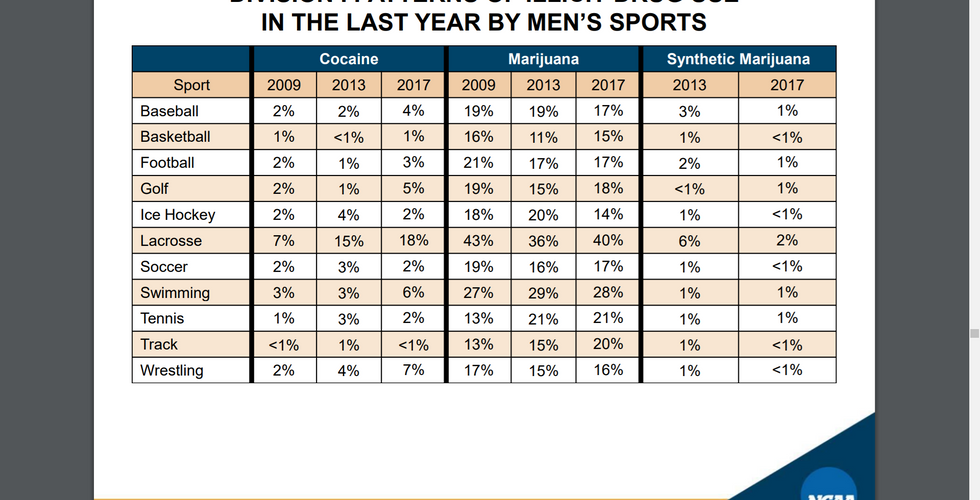


In a story in the Quinnipiac Chronicle, students took a survey and about 45 percent said they used Adderall or a similar drug. People amphetamines to help them with school and usually it does. The student-athletes don’t have that option unless it is prescribed, because it will jeopardize their eligibility and scholarship.
The drug testing process is very random, the NCAA receives a roster for the sports teams, they randomly select athletes and the amount of people that will be tested. The athletes are told a day before the test.
Junior and forward on the men’s basketball team, Kevin Marfo, was tested by the NCAA, and didn’t know what to think. “I was very confused about why I was chosen. I was stressed out because I wanted to know why I was chosen and no one else was, but it’s a pretty quick experience,” he said. It can be a very foreign process if an athlete has not experienced it, and if one person is selected from all their peers and teammates, that can be a nerve-wracking situation.
Andrew Buffalino, a senior and men’s lacrosse player, has not been drug tested by the NCAA or the institution and he feels “the new drug testing process is a good addition to the school,” however, he has mixed feelings. “I don’t think it’s necessary to have a school drug testing policy because it is a waste of money and the NCAA does drug tests anyway,” he said. Hallbach wanted to make the point clear that this policy is not here to make life more difficult for students, but only to help them.
The location of the test for was an issue for DeFilippo as it was in locker room at the new field hockey arena.
“I had an exceedingly hard time navigating my way to my test. In my opinion, the test should have been somewhere more universally known, like the York Hill sports arena,” she said. As new as this is for the student-athletes, it is also the case for the institution, so that could be why it didn't work as smoothly as they would like.
Another issue was the school not providing all the details with this new policy. “I think they could’ve warned students about it earlier. I understand the reason for adding it, but I think students would feel more comfortable with it if they were told at the end of the 2017-2018 school year that starting next year the athletic department will be drug testing athletes,” Buffalino said. The students were notified about this at the start of the school year. The testing was also done during a very stressful time.
Hallbach explained that "The agreement was signed with four weeks left in the semester, so that is why testing happened when it did." Since this is a work in progress, Hallbach hopes that future testing will be done in the middle of the semester.
Note to readers: During the process of writing this story I used Twitter to help me gather news by making lists of accounts that talk about drug use in college athletes. I used twitter to tweet my beat. Lastly, I retweeted any valuable and knowledgeable sources that I found. (Also charts were from a NCAA presentation).


Comments